EN
Materials and Coating Technologies Behind Durable Non Stick Pans.
A durable non stick pan is not created by a slick top layer alone. Its useful life begins with the body, continues through surface preparation, and depends on how each coating layer is applied and cured. For distributors and cookware buyers, that distinction matters: two pans can look similar on a shelf yet deliver very different resistance to warping, uneven browning, and early loss of food release.
From a quality-control perspective, evaluating non-stick cookware starts before the first cooking test. The aluminum grade and casting method, base thickness, surface texture, primer adhesion, mid-coat reinforcement, and top-coat chemistry form one system. This article explains the material choices and coating technology behind a long-lasting pan without treating any single material or coating family as universally superior.
The pan body sets the foundation
Many everyday non-stick pans use aluminum because it is comparatively light and transfers heat quickly. A commonly cited thermal-conductivity value for aluminum is about 205 W/(m·K), which helps explain why an aluminum pan can respond faster than a heavy, low-conductivity body. Heat response is useful, but it is only one part of durability. The geometry of the casting or pressed body determines whether that response is controlled across the cooking surface.
Die-cast aluminum is often selected when a manufacturer wants more freedom to build a substantial body and shape reinforcing features into it. A pressed aluminum construction can also perform well when thickness and forming are controlled. The practical question is not simply “cast or pressed?” but whether the finished base stays stable through repeated heating and cooling. A body that distorts can create hot zones; hot zones place extra thermal stress on the non-stick surface.
In practice, a thin-base pan tends to reveal its limits through uneven browning near the outer cooking area after a few rounds of sautéing. That observation is why heat distribution should be reviewed with base flatness and wall design, not treated as a marketing phrase. For induction-compatible designs, an added ferromagnetic base must also be bonded and sized in a way that supports flatness rather than introducing avoidable stress.
Surface preparation is the first coating decision
A coating cannot compensate indefinitely for poor preparation underneath it. Before spraying or rolling, a cookware factory typically cleans the formed body and prepares the cooking surface so the first layer can anchor consistently. Depending on the manufacturing route, this can involve controlled roughening, blasting, or other treatments that create a uniform profile for adhesion.
That profile needs balance. Too little anchor texture can weaken the mechanical grip between metal and primer. Too aggressive a profile can leave peaks that complicate coverage. Quality teams therefore look for consistency across the center, sidewall, and transition area rather than judging a pan by a glossy finish alone. You can often learn more from a cross-section, a coating-thickness check, and a careful look around the rim than from a single release demonstration.
How multi-layer coating technology supports durability
Modern coating technology commonly uses a system rather than one undifferentiated film. The names vary by supplier, but the functional roles are similar:
- Primer: bonds the coating system to the prepared aluminum substrate.
- Reinforced mid-coat: adds body and can carry wear-resistant particles or structural reinforcement.
- Top coat: provides the low-friction surface associated with easy food release and cleanup.
In a durable non stick pan, the layers must work together through application and curing. Film thickness alone is not a complete quality signal. An overly thick film may not solve poor adhesion, while an inconsistent film can create weak areas even if the average reading appears acceptable. Manufacturers should control spray pattern, line conditions, cure profile, and handling between stages so the system reaches the intended bond and surface continuity.
Wear resistance also comes from formulation choices. Some systems use mineral or ceramic-type reinforcement within selected layers; others focus on different resin architectures or textured designs. Buyers should ask what the supplier validates—such as adhesion, abrasion resistance, thermal cycling, and visual consistency—rather than relying only on terms such as “stone,” “granite,” or “premium.” Those labels can describe appearance and may not, by themselves, define a test method or expected service life.
Heat control protects the coating in real kitchens
Even a well-made durable non stick pan has operating limits. Research on non-stick cookware degradation has examined heating temperature and exposure time as contributors to mechanical change. In ordinary use, the clearest risk is repeated empty-pan preheating at high power. Without food or oil to absorb energy, the center of the pan can rise in temperature quickly, placing unnecessary stress on the coating.
One common failure pattern is preheating an empty pan on high until the center begins to lose its original surface character. The lesson is not that non-stick cookware is fragile; it is that material design and use conditions interact. Medium or medium-high heat, utensils suited to the pan’s care guidance, prompt cleaning after cooking, and avoiding sharp thermal shocks help preserve release performance over time.
What distributors should inspect before approving a range
For a distributor, cookware innovation is valuable when it can be translated into repeatable production controls and clear consumer guidance. A useful approval review combines documents, samples, and practical checks:
- Confirm the body construction: review the declared aluminum process, base geometry, induction solution where relevant, and flatness expectations.
- Ask about the coating stack: establish whether the system uses primer, reinforced intermediate layers, and a functional top coat, plus how application consistency is monitored.
- Review test methods rather than broad claims: ask which adhesion, abrasion, thermal-cycle, and visual-inspection procedures are used for the specific range.
- Cook with production-representative samples: watch egg release, sautéing response, and browning consistency after ordinary preheating—not only a showroom demonstration.
- Align packaging with care instructions: the pan, utensils, cleaning guidance, and heat recommendations should communicate the same use expectations.
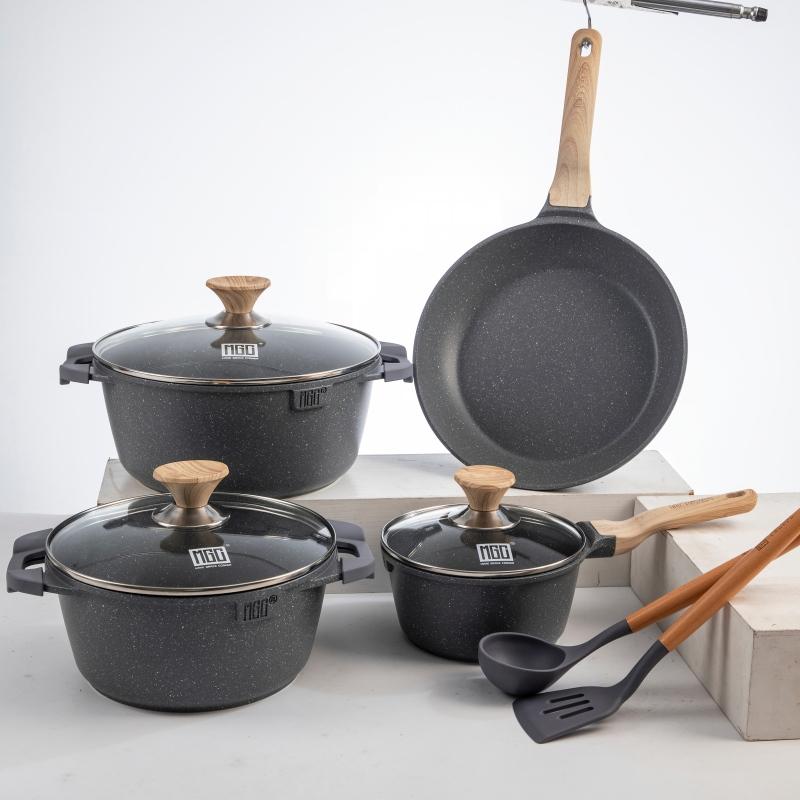
Factory-direct manufacturers such as MGC can help B2B buyers discuss these decisions at the construction and quality-control level when developing die-cast aluminum non-stick cookware. The most useful conversation is specific: intended market, cooktop compatibility, price positioning, finish expectations, and the use pattern the range must support.
The durable-pan equation
A durable non stick pan is the result of a stable aluminum body, considered heat distribution, dependable surface preparation, a compatible multi-layer coating system, and realistic care guidance. No isolated feature guarantees long life. Instead, buyers should evaluate the connections: how the base manages heat, how the coating adheres, how the layers resist wear, and whether the finished pan is designed for the cooking habits of its intended market.
For procurement teams, the practical takeaway is straightforward: look beyond a surface label. When body construction and coating technology are assessed together, it is easier to select cookware that offers consistent cooking performance and a more credible durability story for distributors and end users.