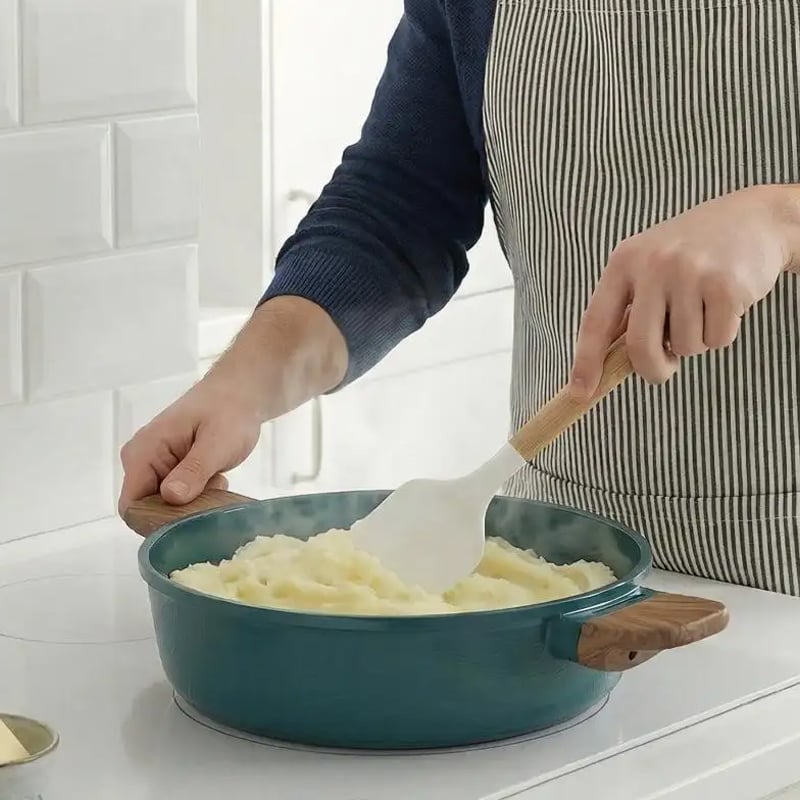
The Kalahari collection is MGC's premium cookware line developed for kitchens where durability and performance must hold up under real cooking conditions. Built around a die-cast aluminum base with an exclusive leather-like textured exterior finish, each piece in the Kalahari range combines structural strength with a distinctive kitchen aesthetic. The Kalahari collection currently includes a frying pan, two stockpot variants, and a complete 9-piece cookware set — covering the core pieces most households need for daily cooking.
Stocking Kalahari cookware for customers in developing-market kitchens means balancing quality expectations with realistic price points, and the Kalahari line by MGC has been designed with that balance in mind. The heat-tolerant die-cast construction addresses one of the most consistent challenges faced by cookware buyers in sub-Saharan Africa: most imported pans are built to Western kitchen standards and fail prematurely under higher-intensity heat sources such as open flame and high-output gas burners.
Each piece in the Kalahari collection is built on die-cast aluminum — a manufacturing process that produces a thicker, more uniform base compared to standard stamped aluminum pans. When comparing two non-stick pans at similar prices, the heavier one often signals a meaningful difference in base construction — not always, but frequently enough to notice. The Kalahari line sits on the heavier end of the mid-range spectrum, which reflects the density and even wall thickness that die-casting enables.
Have you ever bought a cookware set that felt great at first, then started sticking after a few months? That is usually not a bad-luck situation — it is a coating quality and usage signal. The Kalahari collection's ceramic interior is designed for everyday cooking tasks including frying, sautéing, stewing, and simmering, and the Kalahari stockpot variants are specifically suited to long-cook preparations where steady heat retention matters.
Cooking conditions in sub-Saharan Africa and broader Kalahari-region markets often involve higher-intensity heat sources and less controlled temperature environments than in European or urban Asian households. The Kalahari line's die-cast construction and thickened base address this directly. In markets where open flame or high-output gas is standard, a pan with a thin stamped base will often warp or develop hot spots within months. Kalahari cookware is built to resist this failure pattern, maintaining structural integrity under the thermal stress that is common in developing-market cooking environments.
Beyond the Kalahari region, the collection is also suited to households that cook high-heat preparations such as searing steaks, pan-frying fish, or developing a Maillard reaction crust on proteins — tasks where pan temperature stability and non-stick release both matter. The Kalahari frying pan's ultra-thick base locks in heat and enables reliable browning without requiring constant temperature adjustment.
In my experience evaluating cookware options for developing-market retail, the decision usually comes down to whether a buyer needs a single-use piece or a coordinated set. The Kalahari frying pan and individual Kalahari stockpot variants are strong options for buyers who already own other cookware and need specific additions. The Kalahari 9-piece set is more appropriate for new household formation, kitchen upgrades, or gifting contexts where completeness matters.
The PFOA-free claim is now standard across most non-stick cookware — it does not, by itself, differentiate between a premium multi-layer coating and a budget single-layer one. When evaluating Kalahari cookware or any other ceramic-coated product, the more useful questions are: how many coating layers are applied, what is the base material thickness, and whether the product has passed food contact safety testing. For the Kalahari collection, the die-cast base and food-grade ceramic coating reflect a mid-to-premium positioning that is verifiable through the construction weight and exterior finish quality.
For buyers considering the Kalahari line for retail distribution, the textured exterior finish reduces visible surface wear during transport and retail handling — a practical consideration that standard smooth-exterior cookware does not offer to the same degree.
If stovetop type varies across your customer base — which is typical in developing markets where gas, electric, and open flame may all be in use — Kalahari cookware's die-cast construction and flat, thick base make it compatible with a wide range of heat sources. You can usually tell a lot about a pan's base quality just by tapping the bottom: a hollow, thin sound versus a solid, dense sound tells a different story even before you cook.
Health and food safety concerns have elevated scrutiny of non-stick coating ingredients, making PFOA-free and similar safety claims a standard minimum expectation rather than a differentiator. The Kalahari collection meets this baseline and goes a step further by using a food-grade ceramic coating that avoids fluoropolymer chemistry entirely — a distinction that resonates with health-conscious buyers across developing markets where food safety awareness continues to grow.
MGC's focus on developing market buyers informs product design decisions that reflect actual usage conditions rather than assuming Western kitchen standards. The Kalahari line reflects this approach: the die-cast construction is robust enough to handle the variable heat intensity common in Kalahari-region cooking, while the leather-like textured exterior and ceramic coating deliver a premium presentation appropriate for mid-to-high-end retail positioning.
For distributors and wholesale buyers evaluating new cookware lines for developing-market placement, the Kalahari collection offers a consistent, coherent range with a clear visual identity. The Kalahari line's textured exterior finish creates a unified shelf presence across individual pieces and the full Kalahari set, which supports retail display and brand recognition without requiring additional merchandising investment.
Where applicable, ceramic coatings used in the Kalahari collection are subject to food contact safety standards in key export markets — including food-grade material requirements — and Kalahari cookware is positioned to meet these baseline standards. Cookware that performs well in high-heat cooking environments tends to share certain characteristics: a thick, even base, a heat-tolerant coating system, and construction materials that maintain structural integrity under thermal stress. The Kalahari line is built around all three.

 EN