EN
How to Select Reliable Cookware and Bakeware Suppliers for Bulk Orders?
Placing a bulk order for cookware & bakeware is not the same as restocking a retail shelf. When you are responsible for kitchenware sourcing at scale — hundreds or thousands of units for distribution across emerging markets, regional retail chains, or wholesale channels — the cost of a wrong supplier selection decision compounds quickly. Batch inconsistency, coating defects, and missed delivery windows are not inconveniences; they are margin-eroding events that damage your relationships downstream.
The challenge is that most supplier selection guidance is written for retail buyers, not wholesale kitchenware operators. Here is how serious sourcing professionals approach cookware & bakeware procurement when both quality and reliability matter at scale.
1. Factory vs. Trading Company: Get This Right in Wholesale Kitchenware Sourcing
The most fundamental question in kitchenware sourcing is whether you are buying directly from a manufacturer or through an intermediary trading company. Both can offer competitive prices initially, but their ability to support your wholesale kitchenware operations over time differs considerably.
Factory-direct factory supply partners in manufacturing hubs like Dongyang or Jieyang — well-known industrial zones in China's cookware production belt — can typically offer better pricing on repeat orders, faster turnaround on customization or label changes, and direct accountability when quality issues arise. A trading company may have access to multiple factories, which sounds like flexibility, but it introduces an extra communication layer that can obscure what is happening on the production floor.
To verify factory supply status, ask for the factory's business license, a production facility video walkthrough, or evidence of an on-site third-party audit. Be specific: ask for a stamped certification number, not just a scanned certificate photo. Buyers serious about cookware & bakeware quality verification should request at least one site audit before committing to volume production.
My assumption about factory-origin cookware & bakeware changed after evaluating mid-tier Chinese-manufactured sets and finding that coating consistency varied significantly by brand, not just by supplier type. A well-managed factory supply partner with clear QC protocols will consistently outperform a loosely managed operation regardless of label.
2. Evaluate Batch Consistency for Cookware & Bakeware Wholesale Orders
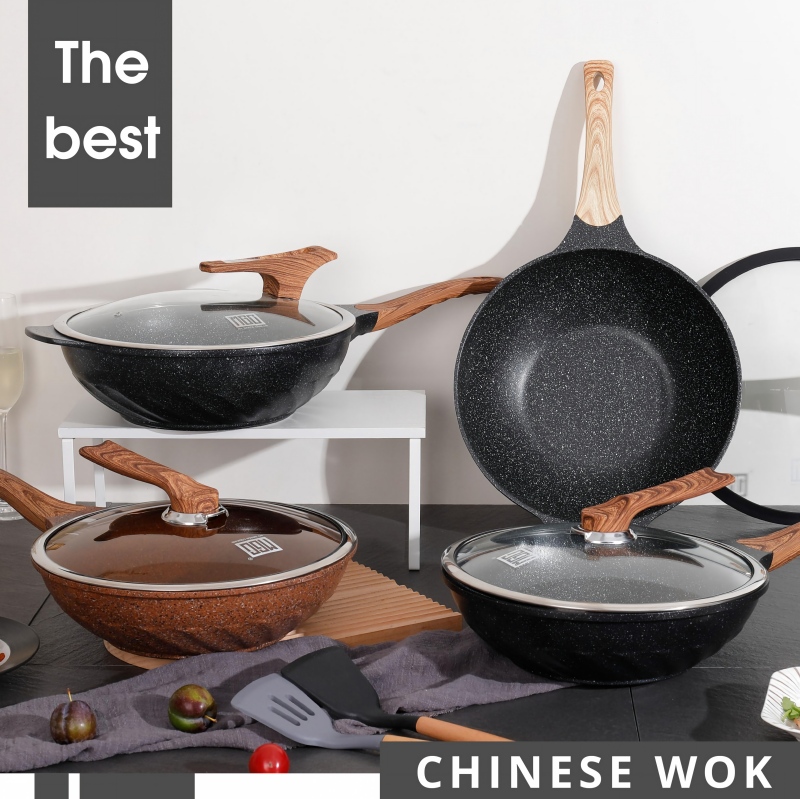
Among the most persistent pain points in wholesale kitchenware procurement is receiving an excellent sample, then finding the first full production run does not match it. This problem is systemic in the mid-range segment and almost entirely avoidable with the right evaluation approach during your supplier selection process.
When reviewing a factory supply partner, ask specifically about their internal quality control at three stages: incoming raw materials, mid-production inspection, and pre-shipment final check. A cookware & bakeware supplier that can walk you through each stage — ideally with batch inspection reports from recent orders — tends to be considerably more reliable than one that offers only general assurances.
A consistently reliable signal when evaluating cookware & bakeware quality is base thickness at the pan edge — the difference between entry-level and mid-range options is usually visible and measurable without specialized tools. When comparing two kitchenware sourcing candidates at similar price tiers, base uniformity and coating application at sidewall junction points often separate consistently produced batches from variable ones.
3. Certifications: Match Them to Your Target Market
Certification requirements for cookware & bakeware vary by destination market, and getting this wrong can result in import delays or rejected shipments. The key frameworks most wholesale kitchenware buyers should verify are:
- LFGB — German food safety standard, widely accepted across the European Union for food-contact materials including non-stick coatings and cookware construction.
- FDA compliance — Required for food-contact products entering the US market. Confirm which specific FDA regulation applies to the coating materials being used.
- ISO 9001 — A quality management system certification that signals consistent production processes, not a product-level food safety guarantee. Valuable as a supplier organization signal, but not a substitute for product-specific compliance.
- BSCI — A social compliance audit standard relevant for European retail partners who require ethical sourcing documentation.
If the factory supply partner serves multiple export markets, they should hold certifications relevant to each. If you are primarily sourcing cookware & bakeware for developing markets where regulatory documentation requirements are lighter, BSCI and ISO 9001 together provide a practical baseline for supplier credibility — even if LFGB or FDA are not mandatory for your distribution channel.
The PFOA-free label is now standard across most non-stick cookware — it does not, by itself, differentiate between a premium multi-layer coating and a budget single-layer product. In your supplier selection process, ask for the coating layer count and the coating supplier's name; established coating chemistry brands are verifiable, which gives you a meaningful quality signal beyond marketing labels.
4. Request Physical Samples Before Any Bulk Cookware & Bakeware Commitment
No written description of a wholesale kitchenware product substitutes for holding it, cooking with it, and stress-testing it. Before placing any bulk order through your kitchenware sourcing process, request physical production samples — not pre-production prototypes — and evaluate them against a short checklist:
- Non-stick release performance after three to five uses without oil
- Handle stability after repeated torque testing by hand
- Base flatness on a level surface (rocking indicates forming inconsistency)
- Lid fit and steam seal integrity when simmering water
- Coating appearance uniformity edge-to-edge, including around riveted handle attachment points
If high-heat searing is your primary use case for cookware & bakeware, invest in a dedicated test session rather than a quick visual check — but if you are sourcing for general-purpose household distribution, the checklist above covers the majority of post-purchase complaints that drive returns and retail dissatisfaction.
5. MOQ, Pricing, and Lead Time Transparency in Kitchenware Sourcing
Minimum order quantities in the cookware & bakeware category can range from a few hundred units per SKU to several thousand, depending on whether the supplier is running standard stock items or production-to-order lines. Smaller international buyers building their initial wholesale kitchenware assortment should prioritize suppliers who can work within realistic minimums on standard SKUs before committing to customized lines.
When evaluating kitchenware sourcing costs, look beyond the unit price to the total landed cost: unit price, packaging specification, export carton configuration, freight terms (FOB vs. CIF), and estimated customs duties at your import destination. A factory supply partner who cannot explain the pricing logic clearly — by SKU, by order volume tier, and by lead time — is unlikely to provide pricing stability across future orders.
Most standard-SKU cookware & bakeware orders from established Chinese manufacturers have a production lead time of 30 to 60 days after order confirmation and sample approval. Custom orders or new mold development will extend this significantly. Factor this into your distribution planning early — before the purchase order is signed, not after.
6. Communication Quality and Long-Term Supply Reliability
The most effective supplier selection decisions in wholesale kitchenware are built on communication clarity, not just price. A factory supply partner who responds promptly, provides clear answers to specification questions, and proactively flags production changes before they affect your shipment is worth more than one who is slightly cheaper but opaque during the order cycle.
For buyers navigating cross-language kitchenware sourcing from Asian manufacturers, working with a supplier whose export team handles communication directly reduces the risk of specification errors on coating, packaging, or labeling. Establish a single point of contact early, confirm all specifications in writing before production begins, and request a pre-shipment inspection report on every first order with a new supplier.
Platforms like Alibaba with Trade Assurance provide a structured channel for smaller-volume international buyers to source cookware & bakeware directly with buyer protection — particularly useful when building a new supply relationship before your order volumes support a more direct arrangement.
Final Checklist: Reliable Cookware & Bakeware Supplier Selection
Before committing to a kitchenware sourcing partner for bulk orders, confirm these seven steps in your supplier selection process:
- Factory status verified — Documentation confirms factory supply vs. trading company status
- Batch consistency demonstrated — QC reports from past production reviewed
- Certifications confirmed — LFGB, FDA, ISO 9001, or market-appropriate equivalents checked
- Physical samples evaluated — Production samples tested against a standard checklist
- MOQ and total landed cost quoted — Pricing transparency confirmed for your wholesale kitchenware volumes
- Lead times confirmed — Both standard-SKU and custom order timelines clarified
- Communication quality assessed — Evaluated through the inquiry and sample stage
Reliable cookware & bakeware suppliers are found through systematic evaluation, not through the lowest price alone. Taking time to qualify a supplier properly through a structured supplier selection process is the most effective way to protect your margins, your downstream relationships, and your retail presence long-term. Whether you are new to kitchenware sourcing or scaling an established wholesale kitchenware operation, the fundamentals remain the same: verify first, order second.